

MATH CLASS 9 CHAPTER 1 NUMBER SYSTEM ALL EXERCISE OF CHAPTER 1 (EXERCISE 1.1,1.2,1.3,1.4,1.5,1.6) MATH CLASS 9 CHAPTER 1 IMPORTANT NOTES
MATH CLASS 9 CHAPTER 1 NUMBER SYSTEM ALL EXERCISE OF CHAPTER 1 (EXERCISE 1.1,1.2,1.3,1.4,1.5,1.6)
1. Number system

Number System is a method of representing Numbers on the Number Line with the help of a set of Symbols and rules. These symbols range from 0-9 and are termed as digits. Number System is used to perform mathematical computations ranging from great scientific calculations to calculations like counting the number of Toys for a Kid or Number chocolates remaining in the box. Number Systems comprise of multiple types based on the base value for its digits.
Exercise 1.1 :

1. Is zero a rational number? Can you write it in the form p/q where p and q are integers and q ≠ 0?
Solution:
We know that, a number is said to be rational if it can be written in the form p/q , where p and q are integers and q ≠ 0.
Taking the case of ‘0’,
Zero can be written in the form 0/1, 0/2, 0/3 … as well as , 0/1, 0/2, 0/3 ..
Since it satisfies the necessary condition, we can conclude that 0 can be written in the p/q form, where q can either be positive or negative number.
Hence, 0 is a rational number.
2. Find six rational numbers between 3 and 4.
Solution:
There are infinite rational numbers between 3 and 4.
As we have to find 6 rational numbers between 3 and 4, we will multiply both the numbers, 3 and 4, with 6+1 = 7 (or any number greater than 6)
i.e., 3 × (7/7) = 21/7
and, 4 × (7/7) = 28/7. The numbers in between 21/7 and 28/7 will be rational and will fall between 3 and 4.
Hence, 22/7, 23/7, 24/7, 25/7, 26/7, 27/7 are the 6 rational numbers between 3 and 4.
3. Find five rational numbers between 3/5 and 4/5.
Solution:
There are infinite rational numbers between 3/5 and 4/5.
To find out 5 rational numbers between 3/5 and 4/5, we will multiply both the numbers 3/5 and 4/5
with 5+1=6 (or any number greater than 5)
i.e., (3/5) × (6/6) = 18/30
and, (4/5) × (6/6) = 24/30
The numbers in between18/30 and 24/30 will be rational and will fall between 3/5 and 4/5.
Hence,19/30, 20/30, 21/30, 22/30, 23/30 are the 5 rational numbers between 3/5 and 4/5
4. State whether the following statements are true or false. Give reasons for your answers.
(i) Every natural number is a whole number.
Solution:
True
Natural numbers- Numbers starting from 1 to infinity (without fractions or decimals)
i.e., Natural numbers= 1,2,3,4…
Whole numbers- Numbers starting from 0 to infinity (without fractions or decimals)
i.e., Whole numbers= 0,1,2,3…
Or, we can say that whole numbers have all the elements of natural numbers and zero.
Every natural number is a whole number; however, every whole number is not a natural number.
(ii) Every integer is a whole number.
Solution:
False
Integers- Integers are set of numbers that contain positive, negative and 0; excluding fractional and decimal numbers.
i.e., integers= {…-4,-3,-2,-1,0,1,2,3,4…}
Whole numbers- Numbers starting from 0 to infinity (without fractions or decimals)
i.e., Whole numbers= 0,1,2,3….
Hence, we can say that integers include whole numbers as well as negative numbers.
Every whole number is an integer; however, every integer is not a whole number.
(iii) Every rational number is a whole number.
Solution:
False
Rational numbers- All numbers in the form p/q, where p and q are integers and q≠0.
i.e., Rational numbers = 0, 19/30 , 2, 9/-3, -12/7…
Whole numbers- Numbers starting from 0 to infinity (without fractions or decimals)
i.e., Whole numbers= 0,1,2,3….
Hence, we can say that integers includes whole numbers as well as negative numbers.
Every whole numbers are rational, however, every rational numbers are not whole numbers.
Exercise 1.2 :

1. State whether the following statements are true or false. Justify your answers.
(i) Every irrational number is a real number.
Solution:
True
Irrational Numbers – A number is said to be irrational, if it cannot be written in the p/q, where p and q are integers and q ≠ 0.
i.e., Irrational numbers = π, e, √3, 5+√2, 6.23146…. , 0.101001001000….
Real numbers – The collection of both rational and irrational numbers are known as real numbers.
i.e., Real numbers = √2, √5, , 0.102…
Every irrational number is a real number, however, every real numbers are not irrational numbers.
(ii) Every point on the number line is of the form √m where m is a natural number.
Solution:
False
The statement is false since as per the rule, a negative number cannot be expressed as square roots.
E.g., √9 =3 is a natural number.
But √2 = 1.414 is not a natural number.
Similarly, we know that there are negative numbers on the number line but when we take the root of a negative number it becomes a complex number and not a natural number.
E.g., √-7 = 7i, where i = √-1
The statement that every point on the number line is of the form √m, where m is a natural number is false.
(iii) Every real number is an irrational number.
Solution:
False
The statement is false, the real numbers include both irrational and rational numbers. Therefore, every real number cannot be an irrational number.
Real numbers – The collection of both rational and irrational numbers are known as real numbers.
i.e., Real numbers = √2, √5, , 0.102…
Irrational Numbers – A number is said to be irrational, if it cannot be written in the p/q, where p and q are integers and q ≠ 0.
i.e., Irrational numbers = π, e, √3, 5+√2, 6.23146…. , 0.101001001000….
Every irrational number is a real number, however, every real number is not irrational.
2. Are the square roots of all positive integers irrational? If not, give an example of the square root of a number that is a rational number.
Solution:
No, the square roots of all positive integers are not irrational.
For example,
√4 = 2 is rational.
√9 = 3 is rational.
Hence, the square roots of positive integers 4 and 9 are not irrational. ( 2 and 3, respectively).
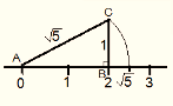
3. Show how √5 can be represented on the number line.
Solution:
Step 1: Let line AB be of 2 unit on a number line.
Step 2: At B, draw a perpendicular line BC of length 1 unit.
Step 3: Join CA
Step 4: Now, ABC is a right angled triangle. Applying Pythagoras theorem,
AB2+BC2 = CA2
22+12 = CA2 = 5
⇒ CA = √5 . Thus, CA is a line of length √5 unit.
Step 4: Taking CA as a radius and A as a center draw an arc touching
the number line. The point at which number line get intersected by
arc is at √5 distance from 0 because it is a radius of the circle
whose center was A.
Thus, √5 is represented on the number line as shown in the figure.
4. Classroom activity (Constructing the ‘square root spiral’) : Take a large sheet of paper and construct the ‘square root spiral’ in the following fashion. Start with a point O and draw a line segment OP1 of unit length. Draw a line segment P1P2 perpendicular to OP1 of unit length (see Fig. 1.9). Now draw a line segment P2P3 perpendicular to OP2. Then draw a line segment P3P4 perpendicular to OP3. Continuing in Fig. 1.9 :

Constructing this manner, you can get the line segment Pn-1Pn by square root spiral drawing a line segment of unit length perpendicular to OPn-1. In this manner, you will have created the points P2, P3,….,Pn,… ., and joined them to create a beautiful spiral depicting √2, √3, √4, …
Solution:
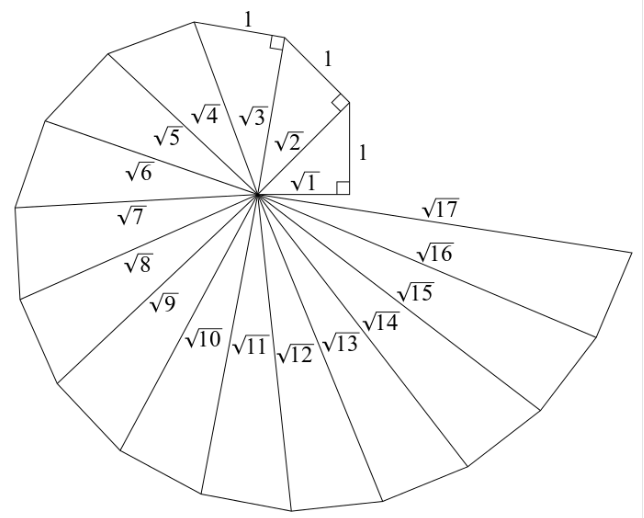
Step 1: Mark a point O on the paper. Here, O will be the center of the square root spiral.
Step 2: From O, draw a straight line, OA, of 1cm horizontally.
Step 3: From A, draw a perpendicular line, AB, of 1 cm.
Step 4: Join OB. Here, OB will be of √2
Step 5: Now, from B, draw a perpendicular line of 1 cm and mark the end point C.
Step 6: Join OC. Here, OC will be of √3
Step 7: Repeat the steps to draw √4, √5, √6
Exercise 1.3:

1. Write the following in decimal form and say what kind of decimal expansion each has :
(i) 36/100
Solution:
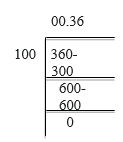
= 0.36 (Terminating) ANSWER
(ii)1/11
Solution:
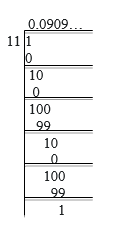
NON-TERMINATIN AND REPTING ANSWER

Solution:

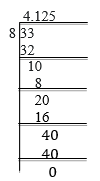
= 4.125 (Terminating) Answer
(iv) 3/13
Solution:
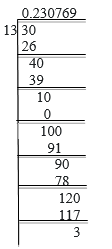

(v) 2/11
Solution:
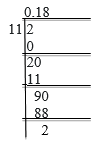

(vi) 329/400
Solution:
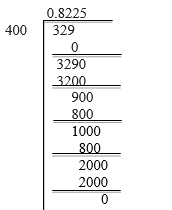
= 0.8225 (Terminating) ANSWER
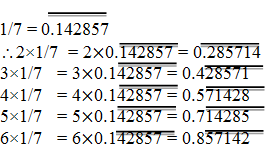
2. You know that 1/7 = 0.142857. Can you predict what the decimal expansions of 2/7, 3/7, 4/7, 5/7, 6/7 are, without actually doing the long division? If so, how?
[Hint: Study the remainders while finding the value of 1/7 carefully.]
Solution:
3. Express the following in the form p/q, where p and q are integers and q 0.
(i) 
Solution:
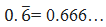
Assume that x = 0.666…
Then,10x = 6.666…
10x = 6 + x
9x = 6
x = 2/3
(ii)
Solution:
= (4/10)+(0.777/10)
Assume that x = 0.777…
Then, 10x = 7.777…
10x = 7 + x
x = 7/9
(4/10)+(0.777../10) = (4/10)+(7/90) ( x = 7/9 and x = 0.777…0.777…/10 = 7/(9×10) = 7/90 )
= (36/90)+(7/90) = 43/90

Solution:
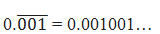
Assume that x = 0.001001…
Then, 1000x = 1.001001…
1000x = 1 + x
999x = 1
x = 1/999
4. Express 0.99999…. in the form p/q . Are you surprised by your answer? With your teacher and classmates discuss why the answer makes sense.
Solution:
Assume that x = 0.9999…..Eq (a)
Multiplying both sides by 10,
10x = 9.9999…. Eq. (b)
Eq.(b) – Eq.(a), we get
(10x = 9.9999)-(x = 0.9999…)
9x = 9
x = 1
The difference between 1 and 0.999999 is 0.000001 which is negligible.
Hence, we can conclude that, 0.999 is too much near 1, therefore, 1 as the answer can be justified.
5. What can the maximum number of digits be in the repeating block of digits in the decimal expansion of 1/17 ? Perform the division to check your answer.
Solution:
1/17
Dividing 1 by 17:
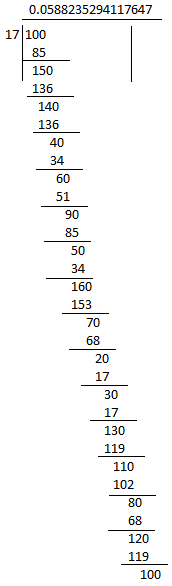
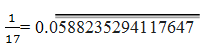
There are 16 digits in the repeating block of the decimal expansion of 1/17.
6. Look at several examples of rational numbers in the form p/q (q ≠ 0), where p and q are integers with no common factors other than 1 and having terminating decimal representations (expansions). Can you guess what property q must satisfy?
Solution:
We observe that when q is 2, 4, 5, 8, 10… Then the decimal expansion is terminating. For example:
1/2 = 0. 5, denominator q = 21
7/8 = 0. 875, denominator q =23
4/5 = 0. 8, denominator q = 51
We can observe that the terminating decimal may be obtained in the situation where prime factorization of the denominator of the given fractions has the power of only 2 or only 5 or both.
7. Write three numbers whose decimal expansions are non-terminating non-recurring.
Solution:
We know that all irrational numbers are non-terminating non-recurring. three numbers with decimal expansions that are non-terminating non-recurring are:
- √3 = 1.732050807568
- √26 =5.099019513592
- √101 = 10.04987562112
8. Find three different irrational numbers between the rational numbers 5/7 and 9/11.
Solution:
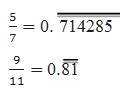
Three different irrational numbers are:
- 0.73073007300073000073…
- 0.75075007300075000075…
- 0.76076007600076000076…
9. Classify the following numbers as rational or irrational according to their type:
(i)√23
Solution:
√23 = 4.79583152331…
Since the number is non-terminating non-recurring therefore, it is an irrational number.
(ii)√225
Solution:
√225 = 15 = 15/1
Since the number can be represented in p/q form, it is a rational number.
(iii) 0.3796
Solution:
Since the number,0.3796, is terminating, it is a rational number.
(iv) 7.478478
Solution:
The number,7.478478, is non-terminating but recurring, it is a rational number.
(v) 1.101001000100001…
Solution:
Since the number,1.101001000100001…, is non-terminating non-repeating (non-recurring), it is an irrational number.
Exercise 1.4 :

1. Visualise 3.765 on the number line, using successive magnification.
Solution:


Exercise 1.5 :

1. Classify the following numbers as rational or irrational:
(i) 2 –√5
Solution:
We know that, √5 = 2.2360679…
Here, 2.2360679…is non-terminating and non-recurring.
Now, substituting the value of √5 in 2 –√5, we get,
2-√5 = 2-2.2360679… = -0.2360679
Since the number, – 0.2360679…, is non-terminating non-recurring, 2 –√5 is an irrational number.
(ii) (3 +√23)- √23
Solution:
(3 +√23) –√23 = 3+√23–√23
= 3
= 3/1
Since the number 3/1 is in p/q form, (3 +√23)- √23 is rational.
(iii) 2√7/7√7
Solution:
2√7/7√7 = ( 2/7)× (√7/√7)
We know that (√7/√7) = 1
Hence, ( 2/7)× (√7/√7) = (2/7)×1 = 2/7
Since the number, 2/7 is in p/q form, 2√7/7√7 is rational.
(iv) 1/√2
Solution:
Multiplying and dividing numerator and denominator by √2 we get,
(1/√2) ×(√2/√2)= √2/2 ( since √2×√2 = 2)
We know that, √2 = 1.4142…
Then, √2/2 = 1.4142/2 = 0.7071..
Since the number , 0.7071..is non-terminating non-recurring, 1/√2 is an irrational number.
(v) 2
Solution:
We know that, the value of = 3.1415
Hence, 2 = 2×3.1415.. = 6.2830…
Since the number, 6.2830…, is non-terminating non-recurring, 2 is an irrational number.
2. Simplify each of the following expressions:
(i) (3+√3)(2+√2)
Solution:
(3+√3)(2+√2 )
Opening the brackets, we get, (3×2)+(3×√2)+(√3×2)+(√3×√2)
= 6+3√2+2√3+√6
(ii) (3+√3)(3-√3 )
Solution:
(3+√3)(3-√3 ) = 32-(√3)2 = 9-3
= 6
(iii) (√5+√2)2
Solution:
(√5+√2)2 = √52+(2×√5×√2)+ √22
= 5+2×√10+2 = 7+2√10
(iv) (√5-√2)(√5+√2)
Solution:
(√5-√2)(√5+√2) = (√52-√22) = 5-2 = 3
3. Recall, π is defined as the ratio of the circumference (say c) of a circle to its diameter, (say d). That is, π =c/d. This seems to contradict the fact that π is irrational. How will you resolve this contradiction?
Solution:
There is no contradiction. When we measure a value with a scale, we only obtain an approximate value. We never obtain an exact value. Therefore, we may not realize whether c or d is irrational. The value of π is almost equal to 22/7 or 3.142857…
4. Represent (√9.3) on the number line.
Solution:
Step 1: Draw a 9.3 units long line segment, AB. Extend AB to C such that BC=1 unit.
Step 2: Now, AC = 10.3 units. Let the centre of AC be O.
Step 3: Draw a semi-circle of radius OC with centre O.
Step 4: Draw a BD perpendicular to AC at point B intersecting the semicircle at D. Join OD.
Step 5: OBD, obtained, is a right angled triangle.
Here, OD 10.3/2 (radius of semi-circle), OC = 10.3/2 , BC = 1
OB = OC – BC
⟹ (10.3/2)-1 = 8.3/2
Using Pythagoras theorem,
We get,
OD2=BD2+OB2
⟹ (10.3/2)2 = BD2+(8.3/2)2
⟹ BD2 = (10.3/2)2-(8.3/2)2
⟹ (BD)2 = (10.3/2)-(8.3/2)(10.3/2)+(8.3/2)
⟹ BD2 = 9.3
⟹ BD = √9.3
Thus, the length of BD is √9.3.
5. Rationalize the denominators of the following:
(i) 1/√7
Solution:
Multiply and divide 1/√7 by √7
(1×√7)/(√7×√7) = √7/7
(ii) 1/(√7-√6)
Solution:
Multiply and divide 1/(√7-√6) by (√7+√6)
[1/(√7-√6)]×(√7+√6)/(√7+√6) = (√7+√6)/(√7-√6)(√7+√6)
= (√7+√6)/√72-√62 [denominator is obtained by the property, (a+b)(a-b) = a2-b2]
= (√7+√6)/(7-6)
= (√7+√6)/1
= √7+√6
(iii) 1/(√5+√2)
Solution:
Multiply and divide 1/(√5+√2) by (√5-√2)
[1/(√5+√2)]×(√5-√2)/(√5-√2) = (√5-√2)/(√5+√2)(√5-√2)
= (√5-√2)/(√52-√22) [denominator is obtained by the property, (a+b)(a-b) = a2-b2]
= (√5-√2)/(5-2)
= (√5-√2)/3
(iv) 1/(√7-2)
Solution:
Multiply and divide 1/(√7-2) by (√7+2)
1/(√7-2)×(√7+2)/(√7+2) = (√7+2)/(√7-2)(√7+2)
= (√7+2)/(√72-22) [denominator is obtained by the property, (a+b)(a-b) = a2-b2]
= (√7+2)/(7-4)
= (√7+2)/3
Exercise 1.6 :

1. Find:
(i)641/2
Solution:
641/2 = (8×8)1/2
= (82)½
= 81 [⸪2×1/2 = 2/2 =1]
= 8
(ii)321/5
Solution:
321/5 = (25)1/5
= (25)⅕
= 21 [⸪5×1/5 = 1]
= 2
(iii)1251/3
Solution:
(125)1/3 = (5×5×5)1/3
= (53)⅓
= 51 (3×1/3 = 3/3 = 1)
= 5
2. Find:
(i) 93/2
Solution:
93/2 = (3×3)3/2
= (32)3/2
= 33 [⸪2×3/2 = 3]
=27
(ii) 322/5
Solution:
322/5 = (2×2×2×2×2)2/5
= (25)2⁄5
= 22 [⸪5×2/5= 2]
= 4
(iii)163/4
Solution:
163/4 = (2×2×2×2)3/4
= (24)3⁄4
= 23 [⸪4×3/4 = 3]
= 8
(iv) 125-1/3
125-1/3 = (5×5×5)-1/3
= (53)-1⁄3
= 5-1 [⸪3×-1/3 = -1]
= 1/5
3. Simplify:
(i) 22/3×21/5
Solution:
22/3×21/5 = 2(2/3)+(1/5) [⸪Since, am×an=am+n____ Laws of exponents]
= 213/15 [⸪2/3 + 1/5 = (2×5+3×1)/(3×5) = 13/15]
(ii) (1/33)7
Solution:
(1/33)7 = (3-3)7 [⸪Since,(am)n = am x n____ Laws of exponents]
= 3-21
(iii) 111/2/111/4
Solution:
111/2/111/4 = 11(1/2)-(1/4)
= 111/4 [⸪(1/2) – (1/4) = (1×4-2×1)/(2×4) = 4-2)/8 = 2/8 = ¼ ]
(iv) 71/2×81/2
Solution:
71/2×81/2 = (7×8)1/2 [⸪Since, (am×bm = (a×b)m ____ Laws of exponents]
= 561/2
MATH CLASS 9 CHAPTER 1 IMPORTANT NOTES OR (NOTES)
1. Natural Numbers: Natural Numbers are the most basic type of Numbers that range from 1 to infinity. These numbers are also called Positive Numbers or Counting Numbers. Natural Numbers are represented by the symbol N.
Example: 1, 2, 3, 4, 5, 6, 7, and so on.
2. Whole Numbers: Whole Numbers are basically the Natural Numbers, but they also include ‘zero’. Whole numbers are represented by the symbol W.
Example: 0, 1, 2, 3, 4, and so on.
3. Integers: Integers are the collection of Whole Numbers plus the negative values of the Natural Numbers. Integers do not include fraction numbers i.e. they can’t be written in a/b form. The range of Integers is from the Infinity at the Negative end and Infinity at the Positive end, including zero. Integers are represented by the symbol Z.
Example: ...,-4, -3, -2, -1, 0, 1, 2, 3, 4,...
4. Fractions: Fractions are the numbers that are written in the form of a/b, where, a belongs to Whole numbers and b belongs to Natural Numbers, i.e., b can never be 0. The upper part of the fraction i.e. a is termed as a Numerator whereas the lower part i.e. b is called Denominator.
Example: 1/2, 3/7, 8/3, etc.
5. Rational Numbers: Rational numbers are the numbers that can be represented in the fraction form i.e. a/b. Here, a and b both are integers and b≠0. All the fractions are rational numbers but not all the rational numbers are fractions.
Example: -2/5, 0.54, 1/5, 13/4, ...
6. Irrational Numbers: Irrational numbers are the numbers that can’t be represented in the form of fractions i.e. they can not be written as a/b.
Example: √2, √3, √.434343, π...
7. Real and Imaginary Numbers: Real numbers are the numbers that can be represented in the decimal form. These numbers include whole numbers, integers, fractions, etc. All the integers belong to Real numbers but all the real numbers do not belong to the integers.
Imaginary Numbers are all those numbers that are not real numbers. These numbers when squared will result in a negative number. The √-1 is represented as i. These numbers are also called complex numbers.
Example: √-2, √-5,...
8. Prime Numbers and Composite Numbers: Numbers that do not have any factors other than 1 and the number itself are termed as Prime Numbers. All the numbers other than Prime Numbers are termed as Composite Numbers except 0. Zero is neither prime nor a composite number.
Example: 2, 3, 5, 7,... are prime numbers and 4, 6, 8, 9, 12,...Arecomposite numbers

0 Comments